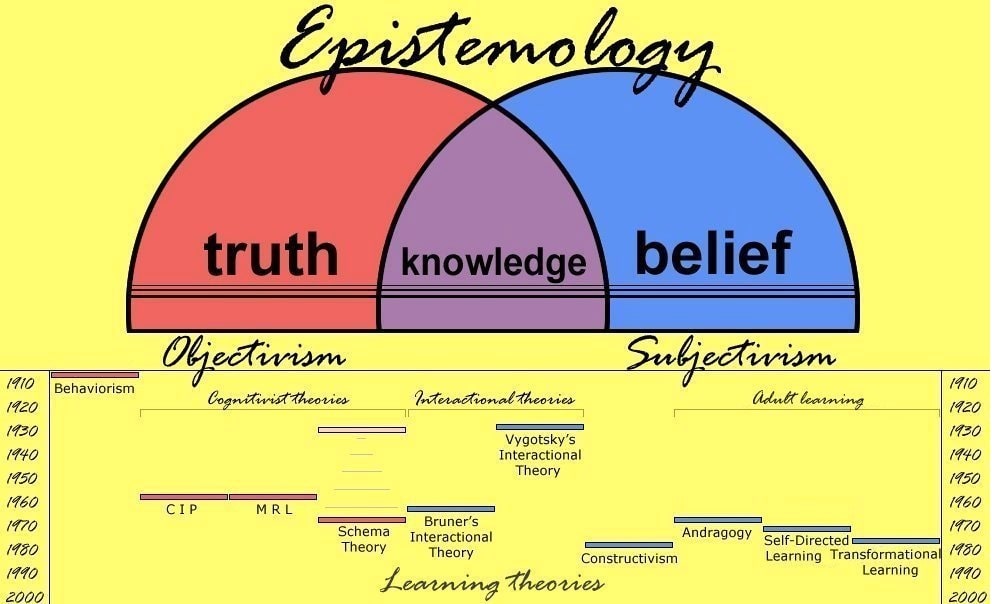
Am I the only one who had to replay these videos a few times back?! And pause it to catch up on my notes?! Even with slowed down playback speeds AND closed captions?! I sure hope not LOL anywho before I go on and spew some possible answers to my potential questions, I wanted to share that I did some brief skimming through other online sources on these paradigms/frameworks and stumbled upon the image that I ended up including above (I will include that it happened to have come from here although I must also preface that the site could be deemed quite sketchy LOL). Nonetheless, not only did it connect to this recent work of ours but it too reminded me of another conversation that is ongoing within another YDEV course of mine (and that being a super interesting and fruitful discourse surrounding what is considered truthful/factual information, the weight that experience/belief carry, and the unintended roles that harm can play when bringing knowledge into a space).
Anywho, my efforts at rounding out and building upon the information learned from the assigned Pat Norman videos didn't end up really helping me determine exactly which ideology I align most with (it actually may have done the opposite LOL). Although if I ~had~ to choose one in this moment, I think I align closer to the ideology of Constructivism. I would say so because of its epistemological belief that knowledge is co-created/built/shared, axiology of humanity/diversity/context in one's identity, and general understanding that the world will forever be much more of a grey area than ever the sole colors of black and white. Next reviewing my list of twenty questions from last week's blogpost, I think some of the answers would look like the following...
Q1: How do I become sure that I am honoring all parts of a young person's intersecting identities at all times?
A1: Looking at this question from the lens of constructivism, I must ensure that cultural and historical context are at the center of posing the question and discovering the answer. Although I don't know the answer- I, too, think that this could be a perfect opportunity for knowledge to be shared and created collaboratively.
Q2: What are the most effective forms of respite for youth within the 2SLGBTQIA+ community who is facing familial banishment, houselessness, or any other type of life crisis?
A2: Approaching this from a constructivist perspective, I think the answer/s would be within the process and participants of the research itself. Its underlying values would encourage diversity and humanity throughout every step of the way- and paired with an emphasis placed on how we all understand and make meaning differently, a very wide range of truths could be brought to the surface.
Q3: What are the most prevalent forms of crises and/or coping skills from the perspective of a youth within the 2SLGBTQIA+ community?
A3: If I were to take a constructivist approach, I believe I may answer the above question by delving head first into every identity that is under every letter and doing so with every research approach and method possible. Now I may have to come to terms with my human capabilities putting limitations on the extent of my research/the research's inability to be infinite or all-encompassing (thus potentially leaving out some possible answers, perspectives, meanings, etc.) but I'd certainly shoot for the stars.
I thank you for reading this far and look forward to next week,
Bailee xxxooo


You’re not alone Bailee, I can’t tell how many times I played the videos or paused halfway, rewind and resumed lol. I like how you explained how you will use constructivism to answer your first question. I think collaborating with youths in order to know how to honour their intersecting identities is definitely a constructivist approach? Are there practical steps you have in mind to answer the question?
ReplyDeleteOmg Aji, thank you so much for making me feel like I wasn't alone in the slight struggle LOL I appreciate the kind words and after some brief thinking, some practical first steps I have for the first question could be 1. Collaboratively locating the studied group of youth's identities, 2. Exploring ways each youth feel that I can honor all parts, and 3. Encouraging youth to share their knowledge on the historical and cultural contexts of all of the varying identities we all bring to the space. Do you have any thoughts?!
Delete